
Assets | RS for Web
BeyondTrust Jump Technology enables privileged users to connect to an unattended remote system to start a session without end-user assistance.
Assets can be installed from the Jump Clients page of the /login interface or from the representative console. Some types of Assets can be created in the web rep console. To create an Asset in the web rep console, click Create at the top of the Asset Management Interface. Full details for creating different Assets are provided later in this guide.
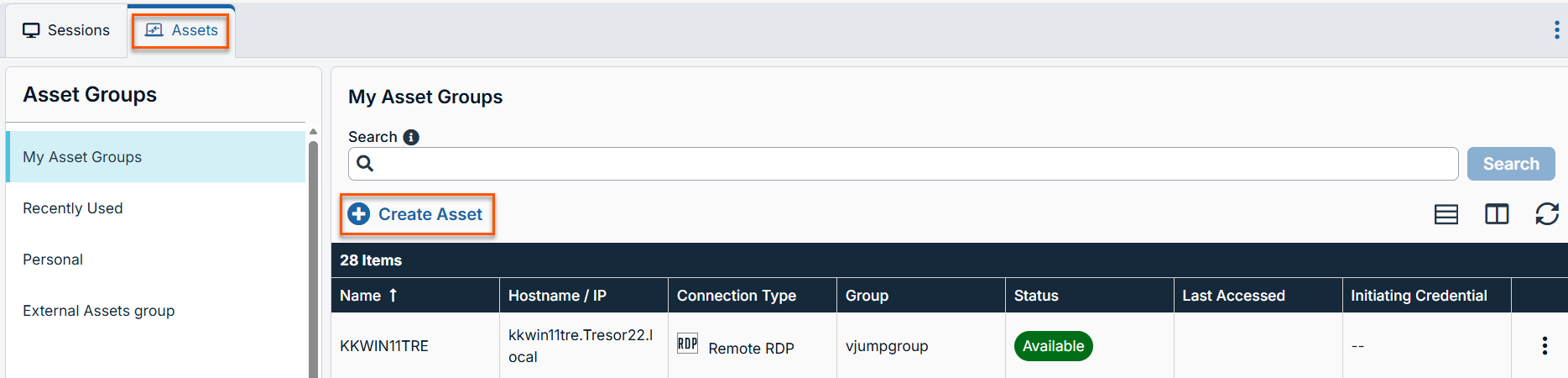
Your account settings determine what Asset permissions you have, including which Asset Groups you can access and which types of Assets you are allowed to use.
Assets are listed in Asset Groups. If you are assigned to one or more Asset Groups, you can access the Assets in those groups, with the permissions assigned by your admin.
Your personal list of Assets is primarily for your individual use, although your team leads, team managers, and users with permission to see all Assets may have access to your personal list of Assets. Similarly, if you are a team manager or lead with appropriate permissions, you may see team members' personal lists of Assets. Additionally, you may have permission to access Assets in Asset Groups you do not belong to and personal Assets for non-team members.
To view details about an Asset, or to copy or edit an Asset, click the vertical ellipsis at the right end of the of the Asset's row. To start a session with an Asset, click the Jump button at the right of the Asset entry.
- The Assets list displays a maximum of 50 Assets.
- If you need to access Assets when no user is available, make sure the session permissions are set either to disable prompting or to default to Allow for unattended sessions.
If an Asset Policy enforces a schedule for this Asset, an attempt to access the Asset outside of its permitted schedule prevents the Jump. A prompt informs you of the policy restrictions and provides the date and time when this Asset is next available for access.
If you have permission to modify Asset Policies, the prompt gives you the option to override the schedule and start a session anyway.
Default credentials for Assets
When starting a Session that requires credentials, after selecting the credentials, you can check Remember as my default. Once a credential is selected as a default, it displays with other Asset details, and subsequent sessions start without requesting credentials.
When a default credential is set, the Asset details (accessed by right-clicking the Asset) include a button for Jump (Change Credentials). This opens the credential selection window, and you can either change default credential, select a different credential for this session, or clear the saved default credential.
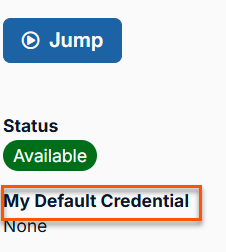
If a default credential is no longer available to the user for that Asset, the next time they start a session with that Asset there is a warning that the requested credentials for starting the session were not found, and the option to continue. If you continue, the credential selection window opens and you can select a credential as usual.
Saving default credentials works only prior to starting an Asset session (i.e. RDP, Remote Jump, Jump, Database Connection, and Web Jump). This feature is not available for Jump Clients.
Jump Client upgrade
You can upgrade Jump Clients from within the web rep console. A Needs Upgrade banner displays under Status, in green if the Jump Client is online, red if offline. You can only upgrade Jump Clients that are online. To upgrade a given Jump Client, click the green banner
In order to be able to upgrade a Jump Client from the Web Rep Console, you must make sure that Automatic Jump Client Upgrades is disabled in /login. To do so, go to /login > Jump > Jump Clients > Upgrades and disable Automatic Jump Client Upgrades. If automatic upgrading is not disabled, Jump Clients needing to upgrade display an Upgrade Pending banner instead.
The rep must also have the right to perform the update. This can be set in /login > Users & Security > Users > Access Permissions > Asset Roles. Make sure that System is also set to Administrator.
Updated 3 months ago
