
Asset Policies | PRA On-prem
Formerly known as Jump Policies
What are Asset Policies?
Asset Policies define the rules that govern how and when users can access assets. On the Asset Policies tab, you can create policies that require approval before a session starts, send email notifications when access is requested or granted, restrict access to specific time windows using a schedule, or require a valid ticket ID from your external ticketing system.
How are Asset Policies useful to my organization?
Asset Policies allow administrators to manage when certain Assets are available, ensuring that access aligns with organizational needs, security requirements, or specific time frames. This helps maintain control and compliance over remote access activities.
How do I access the Asset Policies page?
- Use a Chromium-based browser to sign in to your Privileged Remote Access on-prem URL.
This URL is provided in the BeyondTrust welcome email and includes your site URL followed by /login. - From the left menu, click Asset Management.
The Jump Clients page opens and displays by default. - At the top of the page, click Asset Policies.
The Asset Policies page displays.
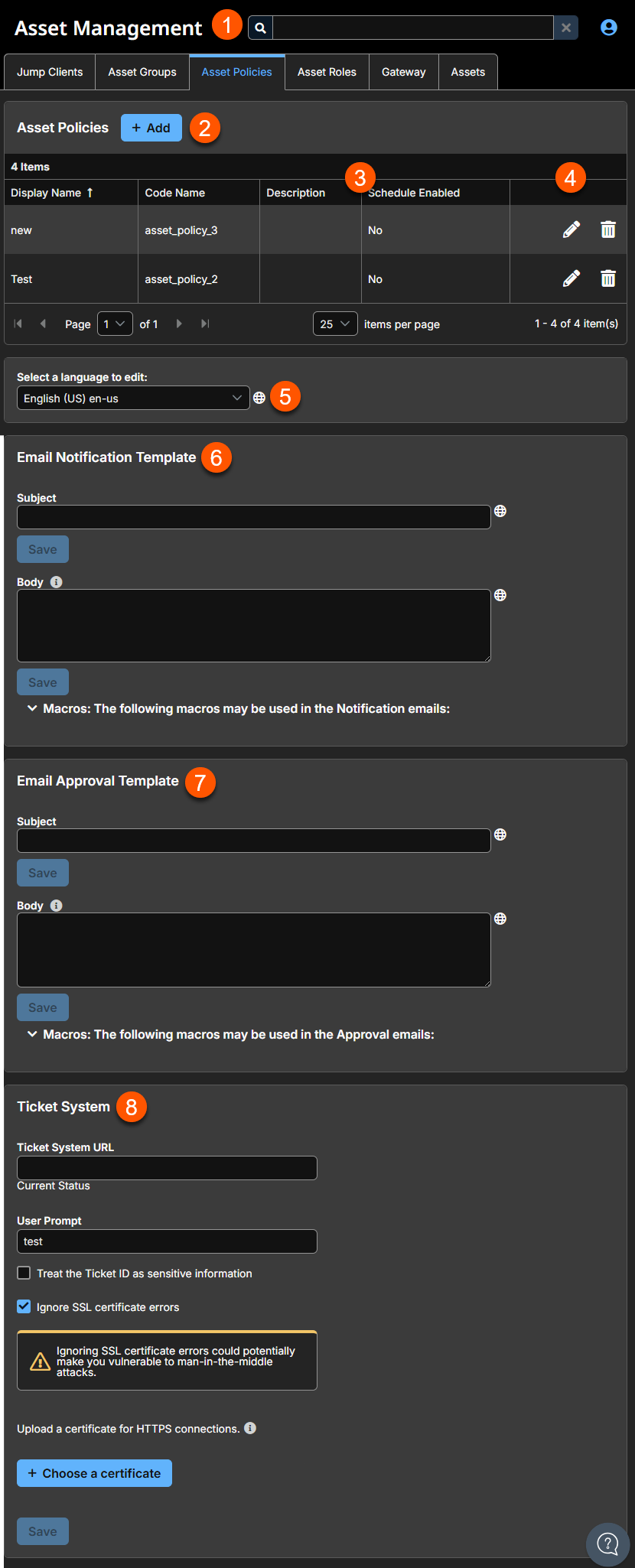
The Asset Policies page
-
Search: Enter keywords to search for areas of the product.
-
Add: Adds a new Asset Policy.
-
Asset Policies columns: The list of Asset Policies.
Asset Policies columns
- Display Name: Unique name of the policy.
- Code Name: Set a code name for integration purposes. If you do not set a code name, one is created automatically.
- Description: A brief description of the Asset Policy.
- Schedule Enabled: Defines if a schedule is enabled.
-
Account Group options: You can edit or delete an Asset Policy.
-
Select a language to edit: Select the language you would like to edit in.
-
Email Notification template: Settings for email notification template.
-
Email Approval template: Settings for email approval template.
-
Ticket System Settings for requests that use a ticket system.
Asset Policies
Asset Policies are used to control when certain Assets can be accessed by implementing schedules.
Add an Asset Policy
-
At the top of the page, click + Add.
The Add a Policy page displays.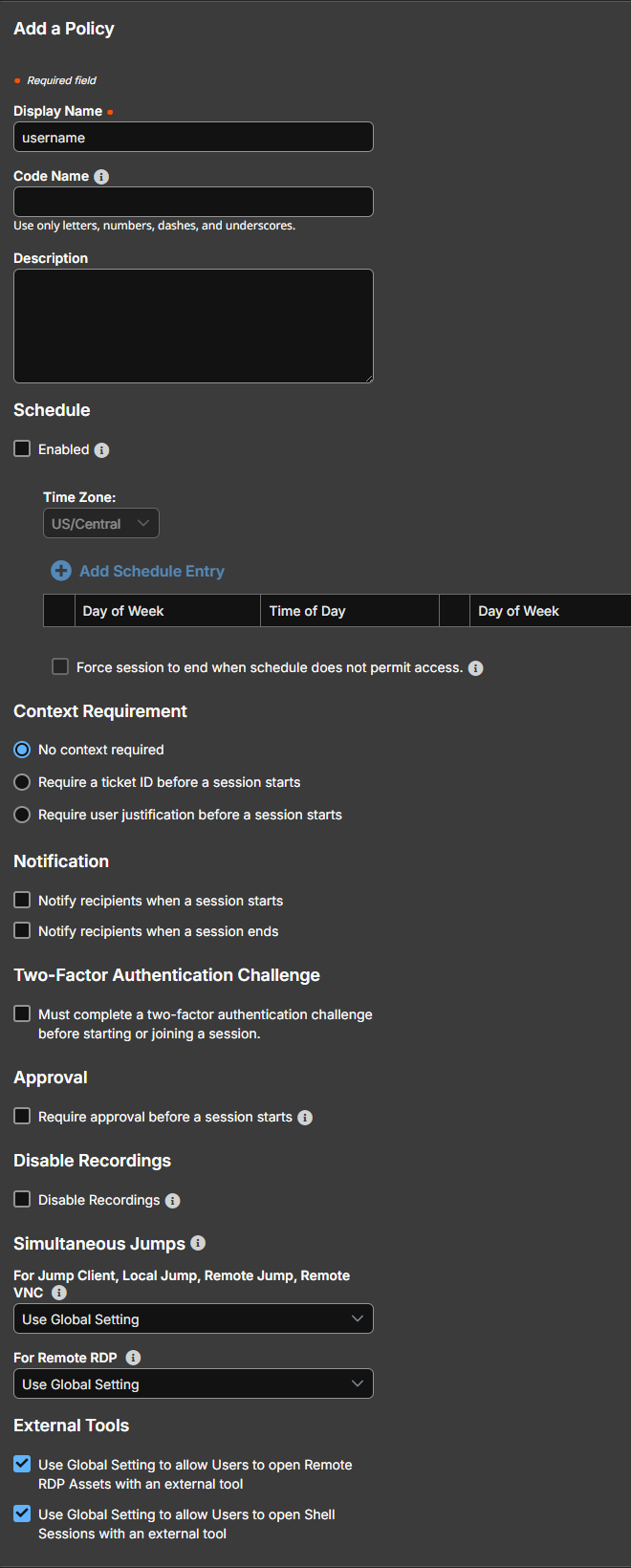
-
Enter a Display name. This name should help users identify this policy when assigning it to Jump Clients.
-
Enter a Code name for integration purposes. If you do not set a code name, one is created automatically.
-
Enter a Description to summarize the purpose of this policy.
-
To configure a Schedule to define when Asset Items under this policy can be accessed, click the Enabled checkbox, and then:
- Set the time zone you want to use for this schedule.
- Click Add Schedule Entry to add one or more schedule entries.
- For each entry, set the start day and time and the end day and time.
- If stricter access control is required, select the Force session to end when schedule does not permit access checkbox. This forces the session to disconnect at the scheduled end time. In this case, the user receives recurring notifications beginning 15 minutes prior to being disconnected.
ExampleIf, for instance, the time is set to start at 8 PM and end at 5 PM, a user can >start a session using this Asset at any time during this window but may >continue to work past the set end time. Attempting to re-access this Asset >after 5 PM, however, results in a notification that the schedule does not permit a >session to start. If necessary, the user may choose to override the schedule >restriction and start the session anyway.
-
Select a Context Requirement for sessions using this policy:
- No context required: no prompt appears at session start (default)
- Require a ticket ID before a session starts: prompt for an external ticket ID
- Require a user justification before a session starts: prompt for a free-text justification
-
To notify a user that a session is either started or ended, select the appropriate Notify recipients when a session starts or Notify recipients when a session ends checkbox.
-
To require an end-user to confirm their identity using a multi-factor authentication challenge before starting or elevating a session, select the Must complete a two factor authentication challenge before starting or joining a session checkbox.
-
If the Require approval before a session starts option is checked, the following happens:
- When a user attempts to start a session with an Asset that uses this policy, a dialog box prompts the user to enter a request reason, time, and duration for the request.
- An approval message is sent to the designated recipients via email and to the access console if the recipients are logged in.
This option cannot be used if a Schedule is enabled.
-
If Disable Recordings is checked, sessions started with this Asset Policy are not recorded even if recordings are enabled on the Configurations > Options page. This affects Screen Sharing, User Recordings for Database Connection, and Command Shell recordings.
-
Simultaneous connections provide a way for multiple users to gain access to the same Asset without having to be invited to join an active support session by another user.
By using the For Jump Client, Local Jump, Remote Jump, Remote VNC field, you can create new sessions. The options you can choose are the following:
Value Name Description Join Existing Session Provides a way for multiple users to gain access to the same Asset without an invitation to join an active session by another user. The first user to access the Asset maintains ownership of the session. Users in a shared session see each other and can chat. Users can join a session that was started from another copy of a Jump Client in a different Asset Group. Session permissions are based on the original Jump Client that started the session.
Once the first user is in a session, subsequent users are able to enter the session. The first user receives a notification that another user has joined the session, but the first user does not have an opportunity to deny access before other user joins.
Disable Ensures only one user can connect to an Asset at a time. Only an invitation by the user who originated the session can allow for a second user to access the session. Use Global Setting If this setting is selected, it uses the values that are configured on the Asset Management > Assets > Asset Settings page. From the For Remote RDP field, you can create new sessions which connect to a specific RDP Asset. The options you can choose are the following:
Value Name Description Start a New Session Provides a way for multiple users to gain access to the same Asset without an invitation to join an active session by another user. For RDP, a new independent session starts for each user who jumps to a specific RDP Asset, and the RDP configuration on the endpoint controls any further behavior regarding simultaneous RDP connections. Disable Ensures only one user at a time can connect to an Asset. Only an invitation by the user who originated the session can allow for a second user to access the session. Use Global Setting If this setting is selected, it uses the values that are configured on the Asset Management > Assets > Asset Settings page. -
Under External Tools you can select these option:
- Use Global Setting to allow Users to open Remote RDP Assets with an external tool.
- Use Global Setting to allow Users to open Shell Sessions with an external tool.
-
Click Save at the top of the page.
Edit an Asset Policy
- Locate the Asset Policy you want to edit from the list.
- Click
 .
.
The Edit Policy page displays. - Edit the policy details. The details you can edit are the same as the Add a Policy page details.
- Click Save at the top of the page.
Delete an Asset Policy
Two factor authentication challenge
For additional security, the Asset Policy can require an end-user to confirm their identity using a multi-factor authentication challenge before starting or elevating a session. Check to require this.
Simultaneous connections
For Jump Client, Local Jump, Remote Jump, Local VNC, Remote VNC, Intel vPro
If this option is set to Use Global Setting, then the simultaneous Jump setting configured on Asset Management > Assets > Asset Settings will be used.
Set this option to Join Existing Session to provide a way for multiple users to gain access to the same Asset without an invitation to join an active session by another user. The first user to access the Asset maintains ownership of the session. Users in a shared session see each other and can chat.
If Join Existing Session is selected, there is an option to apply the setting to copies of Jump Clients.
- If checked, a user can join a session that was started from another copy of a Jump Client in a different Asset Group. Session permissions are based on the original Jump Client that started the session.
- If not checked, a user cannot join a session that was started from another copy of a Jump Client, unless it is the same Asset Group.
Set this option to Disallow Jump to ensure only one user can connect to an Asset at a time. Only an invitation by the user who originated the session can allow for a second user to access the session.
For Remote RDP, Local RDP
If this option is set to Use Global Setting, then the simultaneous Jump setting configured on Asset Management> Assets > Asset Settings will be used.
Set this option to Start New Session to provide a way for multiple users to gain access to the same Asset without an invitation to join an active session by another user. For RDP, multiple users may gain access to an Asset, but each starts an independent session.
Set this option to Disallow Jump to ensure only one user at a time can connect to an Asset. Only an invitation by the user who originated the session can allow for a second user to access the session.
Email notification template
You can use this section to create a template for email notification by following these steps:
- In the Subject field, type the intent of the notification.
- Click Save.
- In the Body field, type the details of the notification.
- Click Save.
Emails are sent using a mailto: URL which has different length limitations on different platforms. Exceeding this limit may cause generated emails to appear truncated or a failure to launch the email software. Consider this limitation when using Macros, which count towards this limit when expanded.
Macros for email notification template
| Macro | Purpose |
|---|---|
| %CONTENT% | The main content for the request notification. For example, "A session has started." |
| %EVENT.NAME% | A string representing the name of the event. For example:
|
| %EVENT.TIME% | The time the event occurred according to the Secure Remote Access Appliance. |
User Properties
| Macro | Purpose |
|---|---|
| %USER.DISPLAY_NAME% | The display name of the user that started the session. |
Asset Properties
| Macro | Purpose |
|---|---|
| %JUMP_ITEM.NAME% | The name of the Asset. |
| %JUMP_ITEM.COMMENTS% | The comments of the Asset. |
| %JUMP_ITEM.COLLECTION.NAME% | The name of the Asset Group the Asset is associated with. |
| %JUMP_ITEM.TAG% | The tag value as configured on the Asset. |
| %JUMP_ITEM.FQDN% | The fully qualified domain name of the Asset. This is supported only for Jump Clients. |
Email approval template
You can use this section to create a template for email approval by following these steps:
- In the Subject field, type the intent of the approval.
- Click Save.
- In the Body field, type the details of the approval.
- Click Save.
Macros for email approval template
| Macro | Purpose |
|---|---|
| %CONTENT% | The main content for the request notification. For example, "A new session authorization request has been created. Click here to respond to the request." |
Authorization Request Properties
| Macro | Purpose |
|---|---|
| %AUTHORIZATION_REQUEST.ID% | The unique ID of the request. |
| %AUTHORIZATION_REQUEST.STATE% | The state of the request. For example:
|
| %AUTHORIZATION_REQUEST.CREATOR.DISPLAY_NAME% | The display name of the user that created the request. |
| %AUTHORIZATION_REQUEST.START_TIME% | The request window start date and time. |
| %AUTHORIZATION_REQUEST.END_TIME% | The request window end date and time. |
| %AUTHORIZATION_REQUEST.DURATION% | The duration of the request window. For example, "2 hours". |
| %AUTHORIZATION_REQUEST.REASON% | The reason for the request provided by the user. |
| %AUTHORIZATION_REQUEST.APPLIES_TO% | This expands to Anyone with Access or the creator's display name depending on the Asset Policy's setting. |
Asset properties
| Macro | Purpose |
|---|---|
| %JUMP_ITEM.NAME% | The name of the Asset. |
| %JUMP_ITEM.COMMENTS% | The comments of the Asset. |
| %JUMP_ITEM.COLLECTION.NAME% | The name of the Asset Group the Asset is associated with. |
| %JUMP_ITEM.TAG% | The tag value as configured on the Asset. |
| %JUMP_ITEM.FQDN% | The fully qualified domain name of the Asset. |
Ticket system
If your service requests use ticket IDs as part of the change management workflow, you can connect your ticket IDs to endpoint access in BeyondTrust by following these steps:
- In the Ticket System section, for the Ticket System URL field, type the URL for your external ticket system. The URL must be formatted for either HTTP or HTTPS. If an HTTPS URL is entered, the site certificate must be verified for a valid connection.
- In the User Prompt field, type the dialog text you want access console users to see when they are requested to enter the ticket ID required for access.
- If your company's security policies consider ticket ID information as sensitive material, check the Treat the Ticket ID as sensitive checkbox.
If this checkbox is checked, the ticket ID is considered sensitive information and asterisks are shown instead of text. You must use an HTTPS Ticket System URL. If an address with HTTP is entered, an error message appears to remind you HTTPS is required.
When this feature is enabled, you cannot bypass issues with SSL certificates by checking the Ignore SSL certificate errors box. This means you must have a valid SSL certificate in place. If you try to check the Ignore SSL certificate errors box, a message appears stating that you cannot ignore SSL certificate errors.
When the Ticket ID is sensitive, the following rules apply:
- Both the desktop and the web access consoles show asterisks instead of text.
- The ticket is not logged anywhere by the access console.
- Click the Ignore SSL certificate errors checkbox if you do not want to include certificate validation information when it contacts your external ticket system.
- Click Choose a certificate to upload the certificate for the HTTPS ticket system connection to your Appliance. If your certificate is uploaded, the Appliance uses it when it contacts the external system. If you do not upload a certificate and the Ignore SSL certificate errors checkbox below this setting is checked, the Appliance optionally falls back to use the built-in certificate store when sending the request.
When the Ignore SSL certificate errors box is checked, the Appliance does not include the certificate validation information when it contacts your external ticket system.
Certificates must be in PEM, DER, or CRT format. If no certificate is uploaded, the appliance's built-in certificate store is used to establish trust.
- Click Save.
Updated 3 months ago
