
Google Cloud Platform | Insights
Prerequisites
Before you configure the Google Cloud Platform connector, ensure the following requirements are met.
Google Cloud access
- You have organization-level administrator access to the Google Cloud Console.
- You can create projects, service accounts, and enable APIs within your GCP organization.
- You can assign IAM roles at the organization scope.
- (Optional) If using Google Workspace: You have Super Admin access to the Google Admin Console to configure domain-wide delegation.
Identity Security Insights access
- Administrator access to Identity Security Insights.
- Your Insights site is provisioned and active.
APIs to enable
Detailed steps follow
- Cloud Asset API
- Cloud Logging API
- Cloud Resource Manager API
- Cloud IAM API
- Service Usage API
- Secret Manager API
- Cloud KMS API
- API Keys API
- Discovery Engine API
- (Optional) Admin SDK API, Google Drive API, Google Drive Activity API, Drive Labels API (if using Google Workspace)
- (Optional) Vertex AI API (if enabling Gemini AI)
ImportantThird-party documentation is subject to change. Updates might not be reflected in BeyondTrust documentation. For the most up-to-date information, visit the Google Cloud website.
Configuration paths
Optional integrations
| Integration | When to enable |
|---|---|
| Google Workspace | Your organization uses Google Workspace and you want to collect user, group, drive, and audit data |
| Gemini AI | You want to collect AI agent and model data from Gemini AI |
Cloud environment (if applicable)
| Environment | When to select |
|---|---|
| FedRAMP High | Your organization operates FedRAMP High assured workloads |
| FedRAMP Moderate | Your organization operates FedRAMP Moderate assured workloads only |
| Commercial | All other environments |
FedRAMP Compliance NoticeInsights Commercial is not FedRAMP-compliant. Using it in combination with the following cloud environments may result in data residency issues and loss of compliance:
- FedRAMP High
- FedRAMP Moderate
Step 1: Create the connector in Insights
- From Insights Home, select ☰ → Connectors.
- Click Create Connector beside Google Cloud Platform.
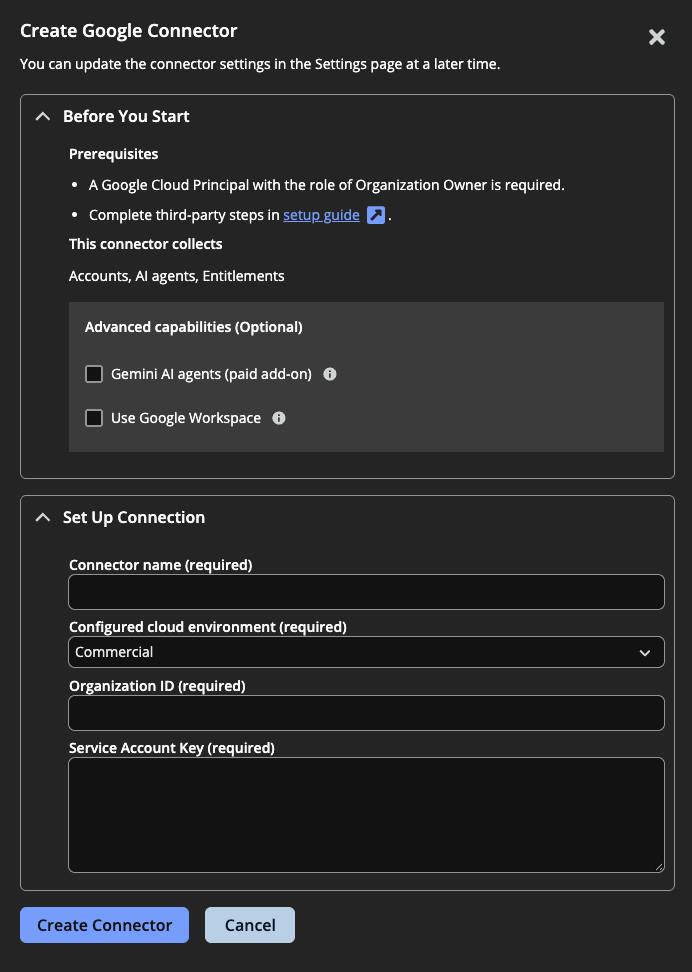
- Enter a human-readable name for your connector.
- Select your cloud environment (if applicable).
Step 2: Select Advanced Capabilities (Optional)
-
Make your selection for Advanced Capabilities (Optional)
-
Gemini AI Agents
- When selected, choose Yes under Allow access to agent model details to also collect agent model details (additional permission required).
-
Use Google Workspace
- When selected, enter an organization admin email in the Admin User Email field
-
Step 3: Retrieve your Organization ID
- In the Google Cloud Console, click the project selector in the top navigation bar.
- Select your organization.
- Navigate to IAM & Admin > Settings.
- Copy your Organization ID.
Paste your Organization ID in the Organization ID field in Identity Security Insights.
Step 4: Run the connector setup script
After you enter your Organization ID, a setup script appears for you to download and run.
python bt-gcp-connector-setup.py setup --org-id <organizationID>The setup script configures the Advanced capabilities you selected above. Confirm your selections before downloading and running the script. Re-running the script is required if you change the settings later.
Step 5: Generate a key for the service account
Copy the Project ID and Service Account ID from the script output, then substitute them for the placeholders in the command below.
- In the top navigation toolbar, click the project selector and select your project.
- Go to IAM & Admin > Service Accounts and select your service account.
- Click the Keys tab.
- Click Add Key > Create new key.
- Select JSON as the key type.
- Click Create. A new key downloads automatically.
- Store the JSON key in a secure location.
Step 6: Set up Google Workspace permission (optional)
Complete this step only if your organization uses Google Workspace and you want to collect user, group, drive, and audit data.
Configure Domain-Wide Delegation
- Navigate to Admin Console > Security > API Controls > Domain-wide Delegation.
- Click Add new.
- Enter the service account's Client ID (the 21-digit number from the
client_idfield in the key JSON file). - Add the following OAuth scopes (comma-separated):
https://www.googleapis.com/auth/admin.directory.user.readonly
https://www.googleapis.com/auth/admin.directory.group.readonly
https://www.googleapis.com/auth/admin.directory.orgunit.readonly
https://www.googleapis.com/auth/admin.directory.rolemanagement.readonly
https://www.googleapis.com/auth/admin.directory.customer.readonly
https://www.googleapis.com/auth/admin.directory.user.security
https://www.googleapis.com/auth/admin.reports.audit.readonly
https://www.googleapis.com/auth/admin.reports.usage.readonly
https://www.googleapis.com/auth/apps.alerts
https://www.googleapis.com/auth/cloud-identity.groups.readonly
https://www.googleapis.com/auth/drive.readonly
https://www.googleapis.com/auth/drive.metadata.readonly
https://www.googleapis.com/auth/drive.activity.readonly
https://www.googleapis.com/auth/drive.labels.readonly
https://www.googleapis.com/auth/drive.admin.labels.readonly
https://apps-apis.google.com/a/feeds/domain/- Click Save.
Final step: Create the connector
- In Identity Security Insights, paste the Service Account Key (the full JSON key from Step 5).
- Click Create Connector.
Navigate to ☰ > Connectors > Configured to confirm connector creation was successful and review connector settings.
Updated 8 days ago
